Vendor deepfake assessment
Summary
deepreality Group offers financial institutions and other enterprise organizations a technology assessment framework to help you validate voice authentication or deepfake detection technologies for your call centers or video conferencing systems. If you're evaluating new vendors, or re-assessing existing tools, we can help you make quantifiable decisions on your business objectives and security level.
Evaluating AI-based technologies, which are non-deterministic, requires a new paradigm for testing that is critically different from standard software processes.
Our independent testing framework means —
You will ensure more rigorous validation of new voice authentication or deepfake detection systems, minimizing risks when you deploy at scale
You won't rely solely on any vendor's performance claims or demos
Our goal is to help you maximize authentication rates, reduce agent handle time, intercept fraud, and become resilient to the threat of deepfakes.
Unbiased. Independent. Technical.
deepreality Group does not accept referral fees or commissions from software vendors. Our loyalty is entirely to our clients' security protocols.
What you get
Expertise in enterprise organization needs — we've built commercial voice authentication and deepfake detection systems, and deployed them for dozens of enterprise organizations worldwide, including several of the largest financial institutions in the world and other Fortune 500 companies
Expertise in state of the art technology — our AI research yielded the industry-leading algorithms for voice authentication, fraud detection and deepfake detection; purpose-built to prevent fraud and deepfake use in the real world
Technology assessment framework — a customized plan for technical due diligence of voice authentication or deepfake detection systems, developed from analyzing real-world deployments of voice authentication and deepfake detection systems
Why it matters
Prior to the mainstream spread of generative AI, synthetic voice clone technologies were largely niche, inaccessible or difficult to use against the average private person. But in recent years we've witnessed massive improvements in the realism achievable by large AI models, able to generate lifelike video/audio clones of specific individuals (deepfakes). AI has not only improved the quality of realistic synthetic content, but the tools are widely available and the flows around malicious use of deepfakes can be fully automated, allowing for fraud and other harms to be dispatched at previously unfathomable scales.
Many vendors have emerged in recent years to seize the opportunity to productize deepfake detection or voice authentication technologies.
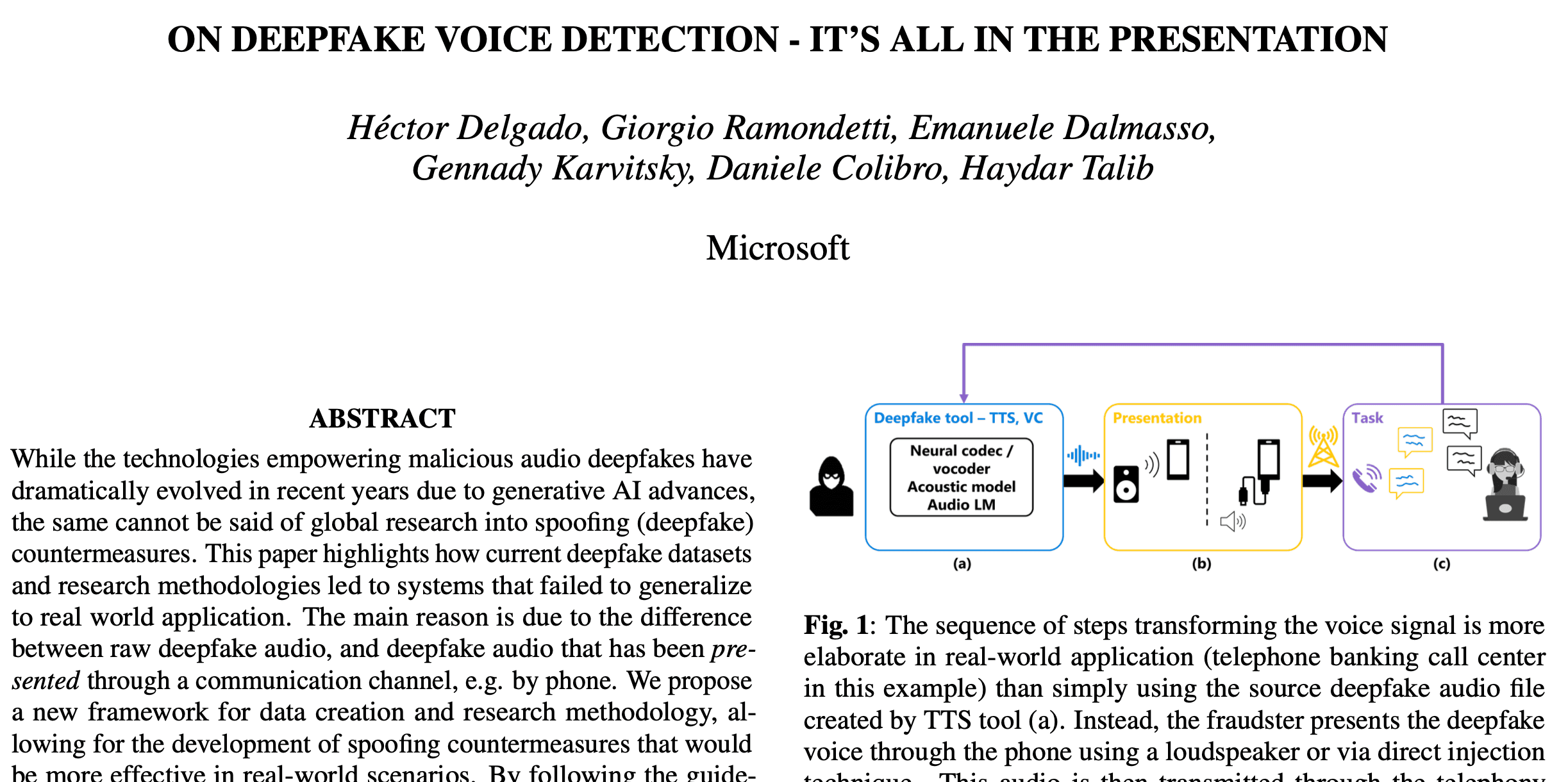
Whether they're new entrants to the market or incumbents, the majority of vendors promote impressive performance metrics that are based on unrealistic lab results. The gap between lab and the real-world is ever widening, which means that production performance can be far worse than what is promised or apparent in standard testing. We even wrote a paper about it.
If you're considering adopting a new authentication or deepfake detection product, you will need a way to quickly and reliably assess vendors for an initial selection; you will also need to do this on an ongoing basis to ensure that the technology you paid for works as intended.
Deepfakes are a direct attack on trust between people, which is a critical part of many enterprise organizations. If you're ready to invest in an authentication or deepfake detection solution, you want to make sure you can rely on it to help establish and protect that trust.
Our Assessment Framework
Plan — Given your current progress, we develop a plan on how to collect data or otherwise test any authentication or deepfake detection systems in question
Assessment — We support your team to carry out statistically meaningful and realistic tests; we aim for a balance of scientific rigor and practical considerations. Some of the things we will look to assess include (but not limited to) -
Resilience to latest Frontier AI models — adversarial red-teaming
Performance for your environment, whether it's your call centre or video conferencing platform
Accuracy tradeoffs (False Acceptance Rate vs False Rejection Rate)
Resilience to broad set of attacks (synthetic media, voice alteration, presentation)
Analysis — We review outcomes and support you in any followups or iterations with vendors
Key Deliverable — We prepare a clear report based on industry best practices from a technical (including FAR/FRR metrics) and business objectives (impact to security, operational efficiency, CSAT) perspective. The vulnerability report will include a detailed breakdown of the strengths and breakpoints of vendor technologies, as well as guidance on mitigating risks or making further adjustments.
Optional add-ons
Follow-up — We provide guidance during integrating and deploying the authentication or deepfake detection systems you adopt
Periodic analysis — We support you in reviewing performance on a regular basis (quarterly or annual) to help maintain confidence in the system's robustness to deepfakes